The fence
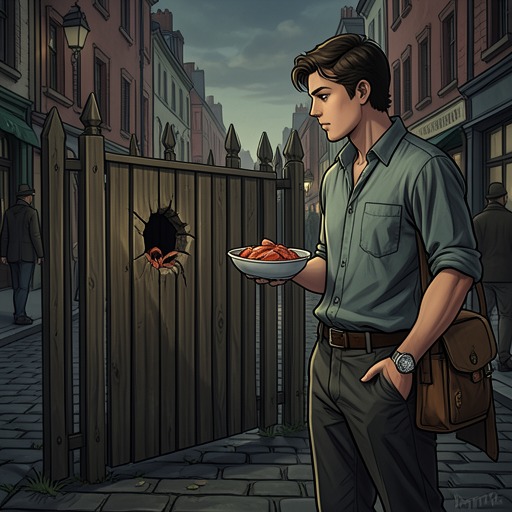
Blind Willow, Sleeping WomanThe fence is an image for the divisions created by choices that may seem ordinary until their consequences become irreversible. In Singapore, the young man and his girlfriend use it to describe the difference between a life that has gone right and one that has crossed into fear and alienation; after he discovers the worms in her stomach, the image returns as a boundary he believes they have fallen beyond together, though she has not noticed.
The Image of a Choice
The woman first explains the fence while defending her talent for finding the best restaurants. Eating, she says, matters more than people think: at certain crossroads, the choice between a good restaurant and an awful one can change an entire life. Her example gives the image its initial shape. The fence separates two possible outcomes, and choosing a restaurant becomes a small but consequential version of choosing which side of life to inhabit.
The young man accepts the woman’s account of her skill, then responds to her restaurant analogy by observing that life can be frightening. She agrees, raising a mischievous finger as she emphasizes how much more frightening it is than one can imagine. He then asks whether the two of them have fallen on the inside of the fence. She confirms that they have, and he turns at once to the practical question of whether she likes crab. The exchange joins a grand claim about life’s peril to a casual meal, letting the metaphor hover between playful banter and a serious account of chance.
The Singapore Reversal
The image changes meaning after the young man discovers that tiny worms are in his girlfriend’s stomach. While she sleeps, he considers waking her and telling her, but decides not to: she has noticed nothing, and he cannot see that telling her would help. His knowledge places him alone beside an experience that, in his view, has already altered the relationship.
He sits in a rattan chair by the window, breathing slowly and watching the night pass. The world seems to have shifted into a new orbit, and he thinks that everything has changed direction. He plans to return to Tokyo the next day, to the life he left behind, but believes that returning will not restore what existed before. He expects never again to feel toward his girlfriend as he did the day before, and fears that he will no longer be able to get along with himself either.
Falling Outside
The earlier question about being on the fence’s inside is answered by a reversal: the young man now imagines that he and his girlfriend have fallen from a great height onto its outside. The fall is painless and soundless, but it marks an inward break. The shared language of their earlier conversation has become a measure of their separation: he believes they have crossed into a changed existence, while she remains unaware of what he has learned.
The night’s rain and passing clouds punctuate his vigil, but nothing changes in the bedroom. His girlfriend does not wake or even roll over; her shoulder trembles slightly a few times. He longs to sleep and awaken to find everything restored, yet sleep remains beyond reach. The fence thus marks not a choice that can now be reconsidered, but the distance between his knowledge and her unawareness, and between the intimacy he remembers and the relationship he expects to carry back to Tokyo.
The Memory Behind the Metaphor
As dawn approaches, the young man remembers the first night in Singapore, when they passed a little side-street restaurant. Two old Chinese men ate silently; a black dog rested at their feet with its eyes closed; faded umbrellas stood over the tables. His girlfriend tugged at his arm. The scene, which had belonged to the easy beginning of their journey, now seems to have taken place years earlier, although barely three days have passed.
That compressed interval gives the fence its final force. In only three days, the young man feels changed into one of the ominous, ashen old men he associates with the city. The restaurant choice that first made the fence sound like a playful image of good fortune has become inseparable from the discovery that divides him from his girlfriend. The text does not show her learning what he knows; it leaves the decisive crossing suspended in the mismatch between his sense of irreversible change and her continued sleep.